Good for
Common use cases
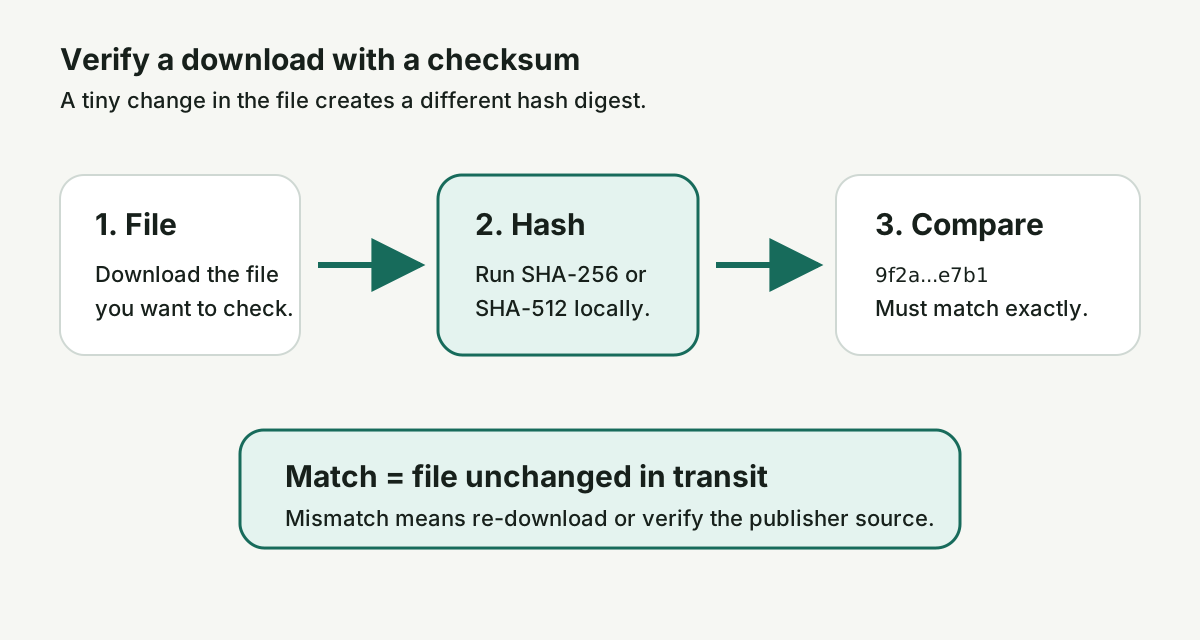
People reach for a hash generator when they need a deterministic, fixed-length fingerprint of some content — a value that is the same every time the input is the same, and (for any modern algorithm) effectively unguessable for any specific target output. The classic shapes are: verifying that a file you downloaded matches the SHA-256 the publisher posted next to the link (Linux distribution ISOs, Bitcoin Core releases, Ledger firmware, npm package tarballs, Homebrew bottles); generating a content-addressable identifier that will be the same on every machine that sees the same bytes (Git uses SHA-1 for commit and blob hashes, IPFS uses SHA-256 for CIDs, Docker uses SHA-256 for image and layer digests); building a deduplication key for a storage layer that should treat byte-identical inputs as the same blob; or feeding a known-input known-output value into a higher-level construct like an HMAC, a Merkle tree, a signed JWT, or a proof-of-work scheme. What a hash generator is *not* for is encrypting data (a hash is one-way — there is no inverse operation that recovers the input from the output), securing a file against being read (a hash is a fingerprint, not a lock), or proving authenticity on its own — a hash that travels alongside the file it describes proves nothing if an attacker can replace both. The constructions that *do* prove authenticity are HMAC (a hash plus a secret key both ends share) and digital signatures (a hash plus an asymmetric key pair); both are strictly richer than a bare hash and live on dedicated tool pages. The right algorithm for new work in 2026 is SHA-256 or SHA-512, both members of the SHA-2 family; SHA-1 is included on this page only as a legacy option for compatibility with systems that still emit SHA-1 fingerprints (Git, deprecated TLS certificate fingerprints, some older Amazon S3 ETags, legacy Subversion checksums), not as a security recommendation. MD5 is intentionally absent — see the FAQ.
Processing mode
Browser-local
Files are processed by your browser. They never reach our servers.

 UUID Generator — Free, In Your Browser